



Hey there! Welcome to Platform Weekly. Your weekly knead of platform engineering dough. Every week, we fold in the best of what the community is building, breaking, and arguing about.
Plus… The hottest party in cloud native. We’re taking over Salt Lake City during KubeCon, then Vegas during re:Invent this November. Will I see you on the dance floor?
Nvidia, OpenClaw, and why your platform team matters more than ever

Do you know what the most successful GitHub project in history is? It ain’t Kubernetes with an embarrassing 128,000 stars, or Linux with a measly 250,000. It’s OpenClaw. Ofc! The open-source agent control framework, with its total lack of any built-in security, governance or guardrails, the epitome of the AI yolomode.
60 days after its launch, as OpenClaw blasted its way to 350,000 stars and the top of the list, Jensen Huang announced on stage at Nvidia GTC “NemoClaw”. OpenClaw BUT with secure sandboxing, model routing, privacy, and lifecycle management.
Why? Because the world’s largest company sees what we have seen in the State of AI in Platform Engineering Vol.2
Only 8% of teams are seeing transformational ROI with AI
Barely 1 in 10 say the model is their biggest blocker to scaling with AI. (Guess what is the #1 blocker - platform readiness!)
And a whopping 29% of platform teams are already having to serve agents as customers
There is a reason Nvidia, AMD, and more are spending billions on open source, releasing a deluge of composable stacks for platform engineering teams to use. And the reason gets increasingly clear when you look at the data. The teams that are succeeding with AI are not winning because they have better access to models or have the highest number of agents burning the most tokens in their orgs.
Mo agents, mo problems. Mo secure agents? Mo moolah
Let’s start with a quick refresher on the four levels of agentic development.
Level 1: Human in the Loop. The human directs every step, while agents act as coding assistants that get prompted
Level 2: Human on the Loop. Humans trigger the work. Agents produce complete code changes in parallel, and humans verify behavior and evidence rather than reviewing every diff
Level 3: Human as Orchestrator. Agents run continuously behind automated validation loops and CI/CD gates, and the platform starts generating work from signals. Humans only get involved when something blocks or fails.
Level 4: Human outside the Loop. Still emerging, and so far only in narrow domains. Agents pick up signals themselves (bug reports or production alerts etc) and fix and deploy on their own. Humans design the boundaries they work within.
It’s a mistake to think that the primary difference between level 2 and level 4 is that L4 has “mo agents”. The difference isn’t that there are more, it’s that the conditions exist for more agents to be made, and used safely and securely.
Think through what has to exist for level 3 and 4 to be possible. You need governed, machine-executable paths. You need agent identity, sandboxing, clean data guardrails, effective context engineering. It’s an order of magnitude more, though, than at any level below. It’s not the realm where you can simply RBAC your way out of problems.
It’s also the realm where all the value comes from. Bolting an agent like OpenClaw onto your existing workflow barely makes a difference compared to just prompting in Cursor. That’s still Level 1 and 2 territory.
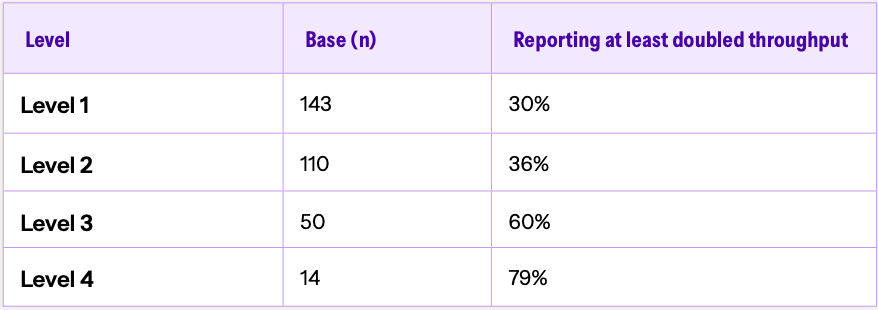
But once you are able to enable full agentic development, the rate at which you can deliver value supercharges (and will continue to do so) as most orgs start with enabling a few core teams before expanding out across the entire enterprise.
If it’s not clear from all this already. All of this tells us that the platform team is more important than ever before. It’s you and your team that will enable agents in the enterprise, that will provide the platform and the paths that let them deliver the kind of value the 8% seeing transformational ROI are reporting already.
And if Nvidia spending billions, and my words here in Platform Weekly aren’t enough to convince you.
Well, you’ve got another 3,500 words diving deep into all of this to make it crystal clear what’s happening, why it’s happening, and how you and your team can make the most of it.
So go dive in. The future is literally yours! Hell yeah.
As always… stay crunchy 🥐
Quick bites

Highlight of the week
Tell us what’s happening in your platform team. We’re digging into where platform engineering is heading right now, and nobody knows better than the people building platforms every day. Take this quick survey and tell us everything, from AI agents blowing everything up to adoption disasters.
From the community
Every PlatformCon talk, past and present, is on the Platform Engineering YouTube channel.