



Hey there! Welcome to Platform Weekly. Your weekly sweep of platform engineering blind spots. Every week, we shine a light on what the community is building, breaking, and arguing about.
Plus...
House of Kube is back at re:Invent on Nov 30, and the last few spots are still open! Come party with us in Vegas :)
The queue will be long as always, so if you’d rather skip 300 people and walk in through the priority lane, you can take the maturity benchmarking survey to see where your platform stands and then request your spot to join our Inner Circle.. Members get guaranteed House of Kube entry, exclusive PlatformCon discounts and first dibs on our roundtables. Free, just like the party!
Infrastructure governance for the agentic era
Agents are the best they’ve ever been at managing infrastructure. And teams are using them more, and trusting them more. But almost no one is getting any ROI from that use.
If we were talking about this a year ago, I would have made a snarky remark about how bad models were at infra (I’ve made many over the last 100 or so Platform Weeklys). Well, the reality was last year that they just weren’t that good at infrastructure yet, and most teams sensibly kept AI away from their cloud.
But the models have caught up on infra since then, and agents can now act on your cloud APIs directly and better than ever. So… are we in a golden era of agent-controlled infra thanks to frontier models? Nope.
The AI implementation plateau we defined last year is still here in a big way. And it goes back to my 2nd favorite stat from the State of AI in Platform Engineering Vol. 2 (350 of you, surveyed in 2026). Only 1 in 10 of you name the model as the main thing stopping you from scaling AI. The #1 answer, at 27%, is platform readiness.
So we recently published Infrastructure governance for platform teams in the agentic era, where Sam Barlien digs into what platform readiness means when it’s your infrastructure the agents are touching. I can’t fit the whole thing into one Platform Weekly, but let me give you some of the juice.
43% of you name agents bypassing existing security controls as a major threat.
35% check AI-generated changes by human review alone, and only 17% run automated validation loops. That’s more than twice as many teams relying on somebody reading a diff.
A quarter of organizations run agents on borrowed human credentials, and another 12% on shared service accounts.
Deploy-time policy only sees what comes through the pipeline, so console fixes, scripts and agents holding credentials never meet the check at all.
The 2 a.m. story
Every good report has a good story, and this one is a database that’s struggling at 2 a.m. The on-call engineer bumps the instance size in the console and goes back to bed, voila, is done. The fix works but never makes it into the code. Then three weeks later the next terraform apply puts the old size back, the database falls over again, and nobody connects the dots.
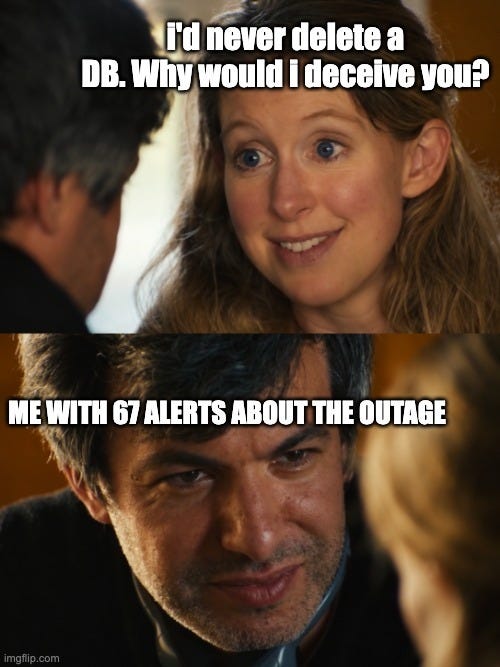
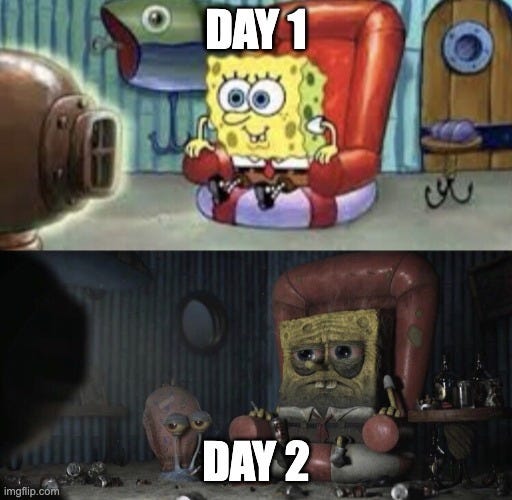
Now picture an agent you’ve asked to cut cloud costs coming across that same database. It sees an instance that’s bigger than the code says it should be, with no owner and no note explaining why, so it shrinks it. You get the same outage on day two instead of week three, and on every other undocumented fix the agent can find. I wouldn’t even call that the agent’s mistake, because it had no way of knowing who owned the database or why it was that size.
The outage is the lucky case
So why such a big deal? A human could’ve done the exact same thing. Well, because the story here isn’t the outage. It’s that the outage was the lucky scenario. At least when a database breaks, somebody gets paged and it’s back up within the hour. What worries me more is everything in the report that doesn’t break anything, like a storage bucket left open after a debugging session, a server launched in a region where you don’t have compliance, a test cluster an agent spun up and forgot, or a backup that got deleted to save money. None of those set off an alarm, so they can sit there for months.
Compare that to the loud stuff. An Alibaba-affiliated research team’s AI agent opened a reverse SSH tunnel to an external host and shifted provisioned GPU capacity to crypto mining…
That one at least got caught pretty fast… the reality is the scope of problems an agent can cause where it gets found quickly, is a lot smaller than the scope of ones where it can take weeks or months of damage before it’s seen.
So what does that mean for you and your platform?
Well, the usual mantra applies here in a big way. Ofc. Shift down (shocker!). Having someone read every diff at deploy only works if every change goes through the pipeline and shows up at a speed humans can handle. That isn’t our reality anymore. The checking has to move into the platform and follow the change wherever it happens.
The report gets specific about what that takes. The platform needs one view of what’s declared in code and what’s actually running. It needs to know who owns each resource in a form it can look up (tags nobody updates don’t count). Every agent needs its own identity and scope. And every fix has to go back through code, since that’s the only place it survives the next apply.
Once those four are in place, your gates can check every change and your people only deal with the exceptions, which is Level 3 of agentic development. That’s human as orchestrator, where agents run long-running work in the background, the platform kicks off that work from signals instead of waiting for a person to ask, and humans only step in when something gets blocked or fails. I told you last week that Level 3 is where the ROI shows up, and infrastructure is no different.
The full report has the five steps to get there, in order, plus three numbers you can track from month one. Get cookin!
As always... stay crunchy 🥐
Quick bites
Quick bites
Highlight of the week
Didn’t catch yesterdays awesome webinar What Day-2 Kubernetes looks like when it’s done right? It’s definitely a much watch!
Upcoming webinar
Not every app deserves the same path to production, so why do most platforms ship them all the same way? Paul Kennedy (Pytilia) and Denis Kennelly show how an agentic platform builds deployment paths matched to each app’s criticality and maps service dependencies automatically, on November 24, 19:00 CET.
Save your spot here!
From the community
Missed a webinar? Catch up on the Platform Engineering YouTube channel!
A cheap guard for the 2 a.m. case: before an agent resizes anything, have it pull the resource's recent changes from CloudTrail. A ModifyDBInstance by a human that never landed in code is exactly the drift that should block the action and open a ticket. Event history keeps 90 days of management events at no charge.